time (n.)
Old English
tima "
limited space of time," from Proto-Germanic *
timon- "time" (cognates: Old Norse
timi "time, proper time," Swedish
timme "an hour"), from PIE *
di-mon-, suffixed form of root *
da- "
cut up, divide" (see tide (n.)).
Antraštė:
dalìs
Reikšmė:
Teil
Straipsnelis:
Ide. kalbų žodžiai, reiškiantys ‘
dalis’, kilę iš įvairių šaknų,
reiškiančių
‘dalinti, skaldyti, skelti’ ir pan. Lie.
dalis, la.
daļa,
pr.
dellīks, šalia veiksmažodžių lie.
dalyti, la.
dalīt, giminiškų r.
dolja ‘pasidalinimas’, skr.
dala- ‘gabalas, fragmentas’, – visi kilę iš
šaknies, matomos skr. dal- ‘sprogti, burst’, lo.
dolāre ‘kirsti, hew’ ir
t. t.
žodis priklauso šakniai
*del- ‘skaldyti, išpjaustyti, apkapoti’, kuri glūdi s. i.
daláyati ‘skaldo’,
dalam neutr. ‘dalis, gabalas’,
Tam kad ištrintum turi atskirti.
delete (v.)
late 15c., "destroy, eradicate," from Latin
deletus, past participle of
delere "destroy, blot out, efface," from
delevi, originally perfective tense of delinere "to daub, erase by smudging" (as of the wax on a writing table), from
de- "from, away" (see de-) + linere "to smear, wipe" (see lime (n.1)). In English, specifically of written matter, from c.1600. Related: Deleted; deleting.
Antraštė:
laikas
Straipsnelis:
Ide. k. žodžių, reišk. ‘laikas’, semant. šaltiniai labai įvairūs, jie gali būti siejami su šiomis sąv.: ‘
tęstis’, ‘
matuoti’, ‘
laikyti’ ir pan. Daugelio kilmė yra neaiški. Lie.
laikas, la.
laiks, giminiški lie. palaikis, laikyti, likti, gr.
λείπω ‘palikti’ ir t. t. Semantinė raida per ‘atidėtas laikas’ (?).
Ide. žodis ‘mėnuo’, ‘
mėnulis’ paprastai kildinamas iš senos šaknies *
meH₁- ‘
matuoti’.
Antraštė:
mẽlas
Reikšmė:
Lüge
Straipsnelis:
Arm.
meł, paprastai pl.
mełkʿ ‘nuodėmė, kaltė, neteisybė’ […]. […] Čia priklauso av.
mairya- ‘melagingai, apgaulingai’, toch. B
śit-malyñe ‘pažeidimas, prasižengimas’ (Windekens [182], Lexique, 131), gr.
μέλεος ‘bergždžias, tuščias’, lo.
malus ‘piktas’, v. air.
mell ‘nuodėmė’, mellaim ‘apgaunu’, lie.
mẽlas ‘Lüge’. Stebinamiausia turbūt yra arm., kelt. ir bl. kalbų sąsaja.
melancholy
c. 1300, "condition characterized by sullenness, gloom, irritability," from Old French
melancolie "black bile, ill disposition, anger, annoyance" (13c.), from Late Latin melancholia, from Greek melankholia "sadness," literally (excess of) "black bile,"
from melas (genitive
melanos) "black" (see
melanin) +
khole "bile" (see Chloe).
melanin (n.) dark brown or black pigment found in animal bodies, 1832, Modern Latin, with chemical suffix -in (2); first element from Greek
melas (genitive
melanos) "black,"
from PIE root *mel- (2) "of darkish color" (cognates: Sanskrit
malinah "dirty, stained, black,"
Lithuanian melynas "blue," Latin
mulleus "reddish"). Related: Melanism; melanistic.
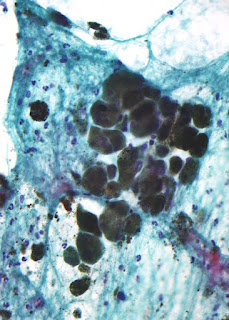 |
| Melanino pigmentas |
|
malice (n.)
c.1300, "desire to hurt another," from Old French
malice
"ill will, spite, sinfulness, wickedness" (12c.), from Latin
malitia
"badness, ill will, spite," from malus "bad" (see mal-). In legal use,
"wrongful intent generally" (1540s).
malicious (adj.)
early 13c., from Old French
malicios "showing ill will, spiteful, wicked" (Modern French malicieux), from Latin
malitiosus "wicked, malicious," from
malitia "badness, ill will, spite," from
malus "bad" (see
mal-). In legal use (early 14c., Anglo-French), it means "characterized by malice prepense."
Antraštė:
mė́las
Reikšmė:
‘mėlynas’
Straipsnelis:
[Aptariama lie. k. būdvardžių su priesaga *
-u̯o- raida]. Lie.
mė́las, la.
mel̃ns ‘juodas’, gr.
μέλᾱς ‘juodas’, s. i.
maliná- ‘purvinas, juodas’. Juose galbūt slypi ide. veiksmažodis *
mē̆l- ‘iš(si)tepti, patamsėti’.
Melas susijęs su mėlynėmis, nes nuo mėlynių išsipurvinama, atsiranda dėmė->nuodėme.
nuodaĩ
1. organizmui kenksmingos medžiagos:
2. prk. žalingos, kenksmingos idėjos, mintys
- stereotipai - tai organizmui kenksmingos medžiagos
- Ps 58,4 Jų nuodai panašūs į gyvatės nuodus, kaip angies, kuri užsikemša ausis.
- Iz 59,5 Jie
peri gyvačių kiaušinius ir audžia voratinklius. Kas valgo jų kiaušinių,
tas miršta. Jei kas tokį kiaušinį sudaužo, iš jo iššoka angis.
Dabar galim kitaip suprasti grupės "SYSTEM OF A DOWN"
"Toxicity" dainos žodžius
Conversion, software version 7.0
# changing the software(desire). Also 7 is prime number.
Looking at life through the eyes of a tire hub
# looking at life through the eyes of tired hub ( "center of interest or activity or importance"), looking through diferent desire.
Eating seeds as a pastime activity
The toxicity of our city, of our city
# indicating thought action, and how it creates disorder ir word
Imagine Dragons "Radioactive" lyrics
[...]
I raise my flags, don my clothes
It's a revolution, I suppose
We're painted red to fit right in
Whoa
[..]
venom (n.)
mid-13c.,
venim,
venym, "poison secreted by some animals and transferred by biting," from Anglo-French and Old French
venim,
venin "poison;
malice," from Vulgar Latin *venimen (source also of Italian veleno, Spanish veneno), from Latin venenum "poison," earlier (pre-classical) "drug, medical potion," also "charm, seduction," probably originally "love potion," from PIE *wenes-no-, from root *
wen- (1) "
to strive after, wish,
desire" (see Venus). Variously deformed in post-Latin languages, apparently by dissimilation. Modern spelling in English from late 14c. The meaning "bitter, virulent feeling or language" is first recorded c.1300.
Antraštė:
laikyti
Straipsnelis:
Ide. k. dažniausiai žodžiai, reišk. ‘laikyti’, sutampa ar labai glaudžiai susiję su žodžiais, reišk. ‘
turėti’, tačiau yra ir kitokių atvejų. Lie.
laikyti, plg. pa.
lāiku ‘jie laiko’,
laikut ‘atlikti’, tai kauzat. veiksmažodis iš lie.
likti (‘laikyti’ kaip ‘priežastis likti’ ‘cause to leaw’), giminiškas gr. λείπω, lo.
linquere ‘likti, palikti’.
divide (v.)
early 14c., from Latin
dividere "to force apart, cleave, distribute," from dis- "
apart" (see
dis-) + -
videre "to
separate," from PIE root *
weidh- "to separate" (see widow; also see with).
separate (v.)
late 14c., from Latin
separatus, past participle of
separare "
to pull apart," from se- "
apart" (see secret) +
parare "make ready, prepare" (see pare). Sever (q.v.) is a doublet, via French. Related: Separated; separating.
apart (adv.)
late 14c., from Old French
à part "to the side," from Latin
ad "to" (see ad-) +
partem, accusative of pars "a side" (see
part (n.)).
part (n.)
mid-13c., "
division, portion of a whole," from Old French
part "share, portion; character; power, dominion; side, way, path," from Latin
partem (nominative pars) "a part, piece, a share, a division; a party or
faction; a part of the body; a fraction; a function, office," related to
portio "share, portion," from PIE root *
pere- (2) "to assign, grant, allot" (reciprocally, "to get in return;" cognates: Greek
peprotai "it has been granted," Sanskrit
purtam "reward," Hittite
parshiya- "fraction, part").
fraction (n.)
late 14c., originally in the mathematical sense, from Anglo-French fraccioun (Old French
fraccion, 12c., "breaking") and directly from Late Latin
fractionem (nominative fractio) "a breaking," especially into pieces, noun of action from past participle stem of Latin
frangere "to break," from PIE root *
bhreg-
"to break" (cognates: Sanskrit (giri)-
bhraj "breaking-forth (out of the mountains);" Gothic brikan, Old English
brecan "to break;"
Lithuanian brasketi "crash, crack;" Old Irish braigim "break" wind). Meaning "a breaking or dividing" is from early 15c.;
sense of "broken off piece, fragment," is from c.1600.
break (v.)
Old English
brecan "to break, shatter, burst; injure, violate,
destroy, curtail; break into, rush into; burst forth, spring out; subdue, tame" (class IV strong verb; past tense
bræc, past participle brocen), from Proto-Germanic *
brekan (cognates: Old Frisian
breka, Dutch
breken, Old High German
brehhan, German
brechen, Gothic
brikan), from PIE root *
bhreg- "to break" (see fraction). Most modern senses were in Old English. In reference to the heart from early 13c. Meaning "to disclose" is from early 13c.
flaw (n.)
early 14c., "a flake" (of snow), also in Middle English "a spark of fire; a splinter," from Old Norse
flaga "stone slab, layer of stone," perhaps used here in a wider sense (see flag (n.2)). Old English had floh stanes, but the Middle English form suggests a Scandinavian origin. "The close resemblance in sense between flaw and flake is noteworthy" [OED]. Sense of "defect, fault" first recorded 1580s, first of character, later (c.1600) of material things; probably via notion of a "
fragment" broken off.
splint (n.)
c.1300, "overlapping plate or strip in armor" (made of metal splints), probably from Middle Low German splinte, splente "thin piece of iron," related to Middle Dutch splinte "splint," probably literally "thin piece cut off," and from a Germanic offshoot of PIE *(s)plei- "
to split, splice" (see
flint). Cognate with Danish splint "splinter," Swedish splint "wooden peg, wedge." Meaning "slender, flexible slip of wood" is recorded from early 14c.; specific surgical sense is attested from c.1400.
flint (n.)
Old English flint "flint; a type of rock noted for hardness and for giving off sparks when struck," common Germanic (cognates Middle Dutch vlint, Old High German flins, Danish flint), from PIE *splind- "to split, cleave," from root *(s)plei- "to splice, split" (cognates: Greek plinthos "brick, tile," Old Irish slind "brick"), perhaps a variant of *spel- (1) "to split, break off." Transferred senses (hardness, etc.) were in Old English
schizophrenia (n.)
1912, from Modern Latin, literally "
a splitting of the mind," from German Schizophrenie, coined in 1910 by Swiss psychiatrist Eugen Bleuler (1857-1939), from Greek skhizein "to split" (see schizo-) + phren (genitive phrenos) "diaphragm, heart, mind," of unknown origin.
cleaver (n.)
late 15c., "
one who splits," agent noun from
cleave (v.1). Originally "one who splits boards with a wedge instead of sawing;" attested as part of a surname from mid-14c. Meaning "butcher's chopper" is from mid-15c.
spoil (v.)
c.1300, "to strip (someone) of clothes, strip a slain enemy," from Old French espillier "to strip, plunder, pillage," from Latin
spoliare "to strip, uncover, lay bare; strip of clothing, rob, plunder, pillage," from
spolia, plural of spolium "arms taken from an enemy, booty;" originally "skin stripped from a killed animal," from PIE *
spol-yo-, perhaps from root *
spel- "to split, to break off" (see spill (v.)).
indulge (v.)
1630s, "to grant as a favor;" 1650s, of both persons and desires, "to treat with unearned favor;" a back-formation from indulgence, or else from Latin indulgere "to be complaisant." Related: Indulged; indulging.
favor (v.) -> palaikyti
mid-14c., "
to regard with favor, indulge, treat with partiality," from Old French favorer, from favor "a favor, partiality" (see favor (n.)). Meaning "to resemble, look somewhat like" is from c.1600. Related: Favored; favoring.


.jpg)


